
Abrasive Wheel Accidents and How to Prevent Them
Abrasive wheel injuries are rarely freak events. They follow a small set of predictable causes — and each one has a well-proven control. Understand the failure modes and you can stop nearly all of them before they happen.
Grinders and cut-off saws are productive tools, but the energy stored in a fast-spinning wheel is unforgiving. When an accident happens, the consequences are often severe: deep lacerations, eye injuries, burns and, in the worst cases, fragments striking the operator or a bystander. The encouraging news is that the causes are well understood, so prevention is largely a matter of applying known controls consistently.
The main ways abrasive wheels cause harm
Most incidents fall into a handful of categories. Recognising them is the first step to preventing them:
- Wheel burst — a cracked, wrong-speed or badly mounted wheel shatters, throwing fragments at high velocity.
- Kickback — the wheel snags or jams and the tool jerks violently toward or away from the operator.
- Contact injuries — a hand or limb touches the spinning wheel, often when reaching past an inadequate guard.
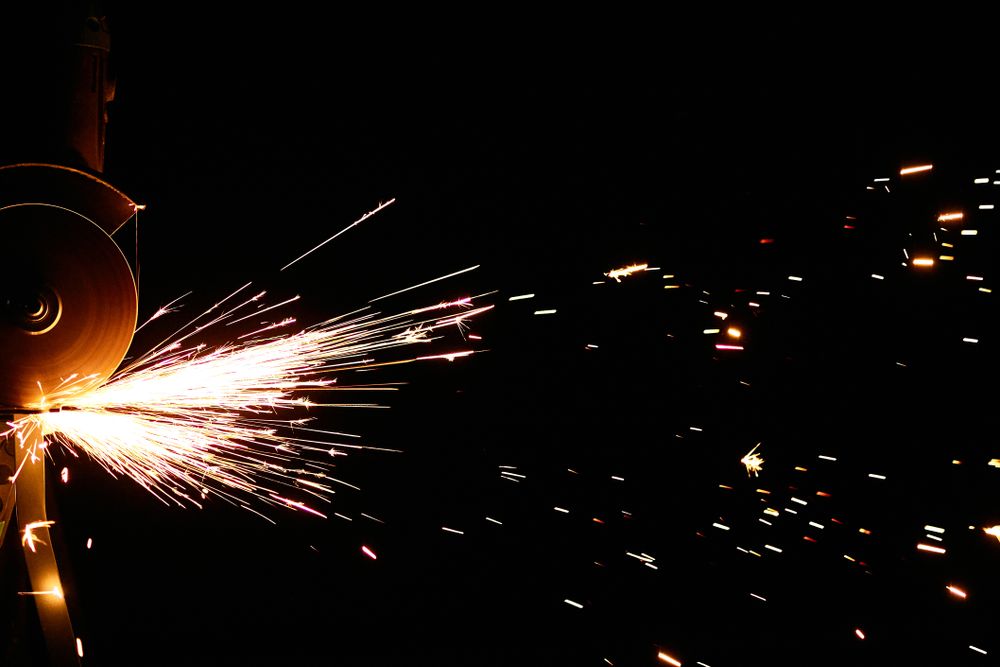
- Ejected particles and sparks — debris strikes the eyes or face, or sparks ignite nearby materials.
- Health effects — long-term harm from dust, noise and hand-arm vibration.
Almost every abrasive wheel accident can be traced to a missing control: the wrong wheel, a removed guard, an untrained operator, or PPE that was not worn.
Preventing wheel burst
Wheel burst is the most catastrophic failure but also one of the most preventable. The controls are simple: only fit wheels rated at or above the machine's spindle speed, inspect and ring-test wheels before use, store them so they do not get damaged or damp, and let only trained people mount them. Our step-by-step guide to mounting an abrasive wheel safely covers exactly how to do this.
Preventing kickback and contact injuries
Kickback usually comes from pinching the disc, using the wrong part of the wheel, or losing control of the tool. Maintain a firm two-handed grip on portable grinders, secure the workpiece, use the disc as intended, and never remove the guard to reach an awkward spot. On bench grinders, keep the work rest gap small so material cannot be dragged in. Above all, keep the guard fitted and correctly adjusted at all times — it is the single most effective barrier between the operator and the wheel.
⭐ Key takeaways
- Wheel burst, kickback, contact, particles and dust cause most incidents.
- Match wheel speed to the machine and inspect before every use.
- Keep guards fitted and adjusted; never reach past them.
- Wear eye, face, hearing and respiratory protection as needed.
- Training and supervision are the controls that hold all the others together.
Protecting against particles, dust and noise
Even routine grinding throws off sparks and fine particles, so eye and face protection is essential, not optional. Where dust is generated — particularly from materials like concrete or stone — respiratory protection and, where practicable, dust extraction or suppression should be used. Hearing protection guards against the noise, and choosing low-vibration tools and limiting exposure time helps protect against hand-arm vibration over the long term.
Abrasive Wheels training from €35
Self-paced, HSA-aligned, certificate the same day — €35 per person.
The human factor: training and supervision
Behind almost every preventable accident is a gap in knowledge or a shortcut taken under time pressure. A trained operator knows why the guard stays on, why the speed rating matters and why the wheel gets inspected — so they are far less likely to take the shortcut that leads to injury. Supervision reinforces this by catching unsafe practices early. The legal expectation for that competence is set out in our overview of the abrasive wheels regulations in Ireland.
Learning from near-misses
Some of the most valuable safety information in any workshop comes from the incidents that did not quite happen. A disc that shattered but was contained by the guard, a grinder that kicked back but was held firmly, a spark that landed near solvents but caused no fire — each of these is a free lesson. Workplaces that record and discuss near-misses, rather than shrugging them off as luck, tend to spot the weak link before it becomes an injury. Encourage operators to flag anything that surprised them, and treat each report as a chance to tighten a control rather than to assign blame.
Building a culture where the controls stick
Controls only work if they are used every single time. That comes from a workplace where stopping to fit a guard or replace a damaged disc is normal and expected, not seen as a delay. Lead by example, make the right equipment easy to reach, and treat near-misses as warnings to learn from rather than incidents to hide. Combined with proper training, this is what turns the theory of prevention into a workshop where abrasive wheel accidents simply do not happen.
None of these controls is complicated or expensive. Taken together, they remove the predictable causes of harm and let a powerful tool do its job safely.