HACCP Explained: A Simple Guide for Irish Food Businesses
HACCP can sound like industry jargon, but at its heart it is just a structured way of thinking about food safety. If you run a café, restaurant, takeaway or any food business in Ireland, here is what it means in plain language.
Few terms cause as much quiet confusion in Irish kitchens as HACCP. It appears on inspection reports, in supplier contracts and in conversations with Environmental Health Officers, yet many staff have never had it explained simply. The good news is that the idea behind it is genuinely straightforward, and once it clicks, it makes daily food safety far easier to manage.
What HACCP actually means
HACCP stands for Hazard Analysis and Critical Control Point. It is a system for identifying where food safety problems could occur and putting controls in place to prevent them. Rather than relying on catching problems after they happen, HACCP is about designing them out of the process from the start.
In practice, a HACCP-based system asks three simple questions about your food operation: what could go wrong, where can we stop it from going wrong, and how do we prove we are keeping it under control?
HACCP is not paperwork for the sake of it. It is a way of catching hazards before they ever reach a customer's plate.
Why it is the law in Ireland
For Irish food businesses, HACCP is not optional. Under EC Regulation 852/2004 on the hygiene of foodstuffs, food business operators are required to put in place and maintain food safety management procedures based on HACCP principles. This is enforced in Ireland by the Food Safety Authority of Ireland (FSAI) and by Environmental Health Officers (EHOs) during inspections.
The requirement applies across the sector, from large manufacturers to small cafés. The level of detail can be scaled to the size and nature of the business, but the underlying obligation to manage food safety on HACCP principles is the same. You can learn more about the wider system in our guide to food safety and the FSAI.
The seven principles of HACCP
A full HACCP system is built around seven recognised principles. Understanding them helps demystify what inspectors are looking for:
- Conduct a hazard analysis. Identify the biological, chemical and physical hazards that could affect your food.
- Determine critical control points (CCPs). Pinpoint the steps where a control is essential to prevent or eliminate a hazard.
- Establish critical limits. Set the measurable boundaries, such as a safe cooking temperature, that must be met at each CCP.
- Establish monitoring procedures. Decide how and when each CCP will be checked.
- Establish corrective actions. Agree what happens if a critical limit is not met.
- Establish verification procedures. Confirm that the system is working as intended.
- Establish documentation and record-keeping. Keep simple records that demonstrate control.
Food Hygiene training from €35
Self-paced, HSA-aligned, certificate the same day — €35 per person.
HACCP in a real kitchen
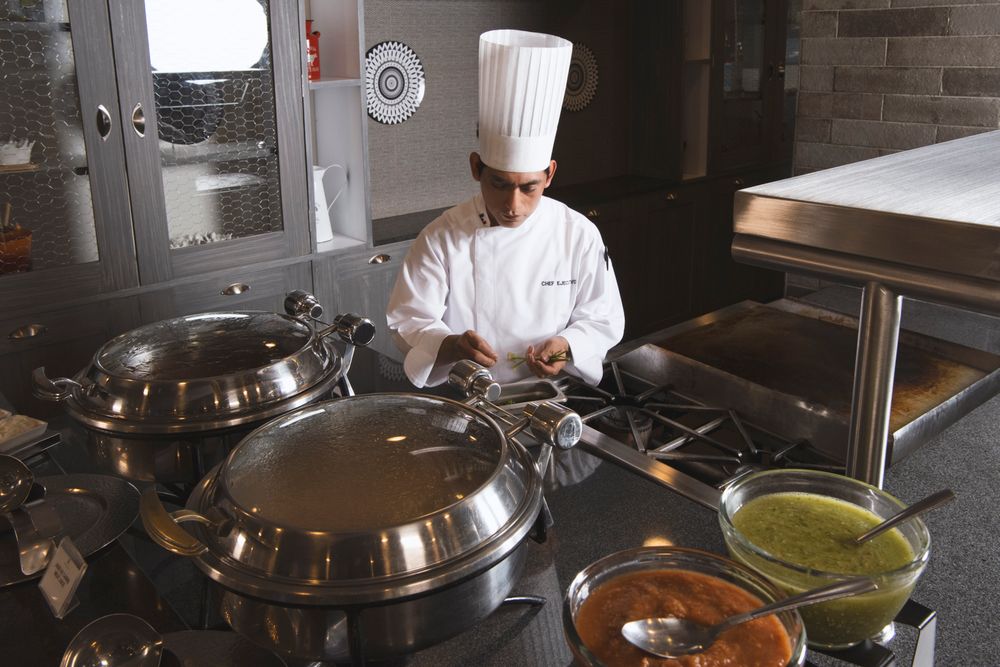
It helps to see HACCP applied to something familiar. Consider serving a cooked chicken dish. The hazard is harmful bacteria surviving the cooking process. The critical control point is the cooking step itself. The critical limit is reaching a safe core temperature. Monitoring means probing the food with a clean thermometer. The corrective action, if it is undercooked, is to continue cooking. And the record is a quick note that the check was done.
Seen this way, HACCP is simply a disciplined version of what careful chefs already do. The structure ensures nothing important is left to memory or chance. Temperature control in particular sits at the heart of many critical points, which is why we cover it in detail in our guide to food safety temperature control.
Why training matters
A HACCP system is only as strong as the people running it. EC Regulation 852/2004 also requires that food handlers are supervised and trained in food hygiene matters appropriate to their role. Staff who understand the reasoning behind a control are far more likely to follow it consistently, even when the kitchen is busy.
Good training gives every team member a shared understanding of:
- What the main food safety hazards are and how they arise.
- Why specific controls, like cooking and chilling temperatures, exist.
- How to monitor and record those controls quickly and reliably.
- What to do when something is not right.
🔑 Key takeaways
- HACCP stands for Hazard Analysis and Critical Control Point — a system to prevent food safety problems.
- It is a legal requirement under EC Reg 852/2004, enforced in Ireland by the FSAI and EHOs.
- The system is built on seven principles, from hazard analysis to record-keeping.
- It can be scaled to suit small cafés as well as large manufacturers.
- Trained staff are essential — a HACCP plan only works if people follow it.
Far from being a bureaucratic burden, HACCP gives Irish food businesses a clear, repeatable way to keep food safe and demonstrate that they are doing so. With trained staff and a sensible plan, it quickly becomes a natural part of how a good kitchen runs.