
Manual Handling in Warehousing and Logistics: Risks and Controls
Few sectors put as much strain on the human body as warehousing and logistics. Pickers walk miles a shift, lift from floor to shoulder height, and reach deep into racking — often against the clock. This guide sets out the warehouse-specific risks and the practical controls that keep order fulfilment moving without putting backs on the line.
Why warehouse work is different
Manual handling exists in nearly every workplace, but warehouses and distribution centres concentrate the hazards in a way that few other environments do. The pace is high, the loads are unpredictable, and the same movements repeat hundreds of times a day. A single picker fulfilling e-commerce orders might handle a feather-light parcel, then a 20-kilogram case of bottled water, then an oddly balanced box of machine parts — all within a couple of minutes.
That mix of variable loads, repetition and time pressure is precisely what makes warehouse manual handling so demanding. Add in the layout of a busy fulfilment centre — long carry distances between aisles, deep pallet racking, and the constant temptation to twist while moving a load rather than turning the feet — and the risk of cumulative musculoskeletal injury climbs quickly.
The main risks in distribution and fulfilment
Understanding where injuries come from is the first step in preventing them. In warehousing, logistics and delivery, the recurring risk factors include:
- Repetitive picking — the same reach-lift-place cycle repeated through an entire shift, building cumulative strain even from light loads.
- Reaching into deep racking — stretching forward to grasp stock at the back of a shelf puts the spine under leverage it is not built for.
- Lifting from the floor or above shoulder height — bottom and top rack levels force awkward postures that no amount of brute strength makes safe.
- Carrying over distance — moving loads across a large fulfilment centre extends the time the body is under load and tires the grip.
- Twisting while moving pallets — turning the trunk under load while shifting a pallet or stacking a cage is a classic trigger for back injury.
Awkward and variable loads make matters worse: a parcel with no clear grip point, a shrink-wrapped pallet with shifting contents, or a box heavier on one side all force the body to compensate. During peak periods — seasonal spikes, sales events and high-volume delivery rounds — the temptation to rush turns these everyday hazards into genuine injuries.
In a warehouse, the danger is rarely one heroic lift. It is the same ordinary movement, done a thousand times under pressure, that wears the body down.
Controls that actually work on the floor
Irish safety law does not set a fixed maximum weight. Instead it is risk-based: the employer must assess each handling task and reduce the risk so far as is reasonably practicable. In a warehouse setting, that usually means a combination of smarter layout, mechanical aids and trained people rather than any single fix.
Design out the hardest lifts
The cheapest injury to prevent is the one the layout never creates. Store fast-moving and heavy items at waist height, in the so-called power zone, so the most frequent lifts avoid both the floor and the top shelf. Reserve high and low rack levels for light or slow-moving stock, and keep aisles clear so loads can be moved without dodging obstacles. Good housekeeping is not cosmetic — a tidy floor is a safer floor.
Let machines do the carrying
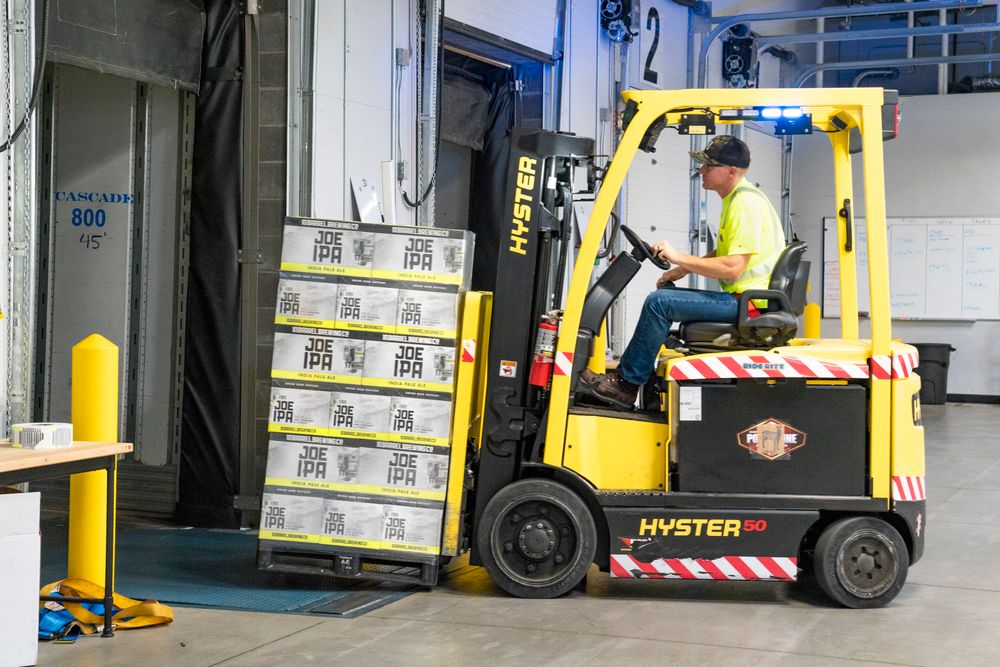
Mechanical aids are the single biggest lever in a logistics operation. Pump trucks and pallet jacks move whole pallets without anyone lifting; powered conveyors carry stock along the pick line; and trolleys and roll cages cut the carry distance a worker covers under load. Reaching for an aid should be the default, not the exception. Where a load genuinely must be lifted by hand, a team lift with a clear plan and a nominated lead beats a solo struggle every time.
Rotate the work and train the people
Even with good aids, repetition remains a hazard. Job rotation — moving staff between picking, packing and replenishment — spreads the load across different muscle groups and breaks up the relentless repetition that causes overuse injury. None of this works, though, without trained staff who recognise a risky task and know the safe technique for it. Pair sound manual handling skills with a proper manual handling risk assessment of your key tasks, and most warehouse injuries become avoidable.
Manual Handling training from €35
Self-paced, HSA-aligned, certificate the same day — €35 per person.
What Irish law requires of warehouse employers
The legal framework is the same one that applies to every Irish workplace, but it bites hard in logistics because the risks are so concentrated. Under the Safety, Health and Welfare at Work Act 2005 and the Safety, Health and Welfare at Work (General Application) Regulations 2007— specifically Chapter 4 of Part 2, which deals with manual handling — employers must first try to avoid hazardous manual handling altogether. Where it cannot be avoided, they must assess the risk and take steps to reduce it.
The approach is risk-based, with no fixed weight limit: a 15-kilogram load lifted repeatedly from a low shelf with a twist may carry more risk than a heavier load lifted once in good conditions. The Health and Safety Authority (HSA) enforces these duties and expects employers both to assess handling tasks and to provide workers with suitable information and training. A certificate on file is the simplest way to show the training duty has been met.
Key takeaways
- Warehouse risk comes from repetition, variable loads and time pressure — not just heavy weights.
- The worst lifts are from the floor, above shoulder height, or with a twist while moving pallets.
- Layout, mechanical aids, job rotation and team lifts cut the risk before it reaches the worker.
- Irish law is risk-based under the 2005 Act and the 2007 Regulations (Chapter 4 of Part 2), with no fixed weight limit.
- Employers must assess handling tasks and train staff — HSA-aligned certification costs €35 per person.
Build it into the daily routine
The controls above only pay off when they are habits rather than posters. Make safe technique part of induction, refresh it as the operation changes, and make the right pump truck or trolley easy to reach so nobody is tempted to shortcut it under pressure. Reinforce the fundamentals with a clear safe lifting technique that every picker can apply without thinking, and back it up with HSA-aligned manual handling training from €35. In warehousing and logistics, the difference between a smooth peak season and a string of back injuries usually comes down to whether the basics were trained, equipped and built into the way the floor runs every single day.