CPR and Defibrillator Basics Everyone Should Know
When a heart stops, the people nearby decide the outcome long before paramedics arrive. Here are the CPR and defibrillator basics every trained first aider — and ideally every colleague — should know.
Why CPR and defibrillation matter so much
When someone suffers a cardiac arrest, their heart stops pumping blood and every passing minute reduces the chance of survival. The two things that make the biggest difference before an ambulance arrives are early, effective CPR (cardiopulmonary resuscitation) and early use of an AED (automated external defibrillator). Both can be performed by an ordinary trained person — you do not need to be a medic.
For Irish employers, the ability to respond to a sudden collapse is part of meeting the general duty of care under the Safety, Health and Welfare at Work Act 2005, and trained occupational first aiders are exactly the people expected to step in under the General Application Regulations 2007, Part 7. This article explains the basics in plain language, but it is not a substitute for hands-on training.
The most useful person in a cardiac emergency is not the most qualified one in the building — it is the one who is willing to start CPR straight away and keep going.
Recognising the emergency
Act quickly if a person is unresponsive and not breathing normally. Gasping or occasional irregular breaths are a warning sign, not a sign of recovery. The basic sequence taught on first aid courses is:
- Check for danger and make sure the area is safe for you and the casualty.
- Check response — gently shake the shoulders and ask loudly if they are okay.
- Open the airway and look, listen and feel for normal breathing for up to ten seconds.
- Call for help — dial 112 or 999, ask for an ambulance and send someone for the nearest AED.
How to perform CPR
If the person is not breathing normally, begin chest compressions without delay:
- Kneel beside the casualty and place the heel of one hand in the centre of the chest, with your other hand on top.
- Keep your arms straight and press down hard and fast — roughly 5 to 6 centimetres deep at a rate of about 100 to 120 compressions per minute.
- Allow the chest to recoil fully between each push.
- If trained and willing, give rescue breaths in a ratio of 30 compressions to 2 breaths; if not, compression-only CPR is far better than doing nothing.
- Keep going until the AED is ready, the person shows signs of life, or professional help takes over.
Key takeaways
- Cardiac arrest survival drops with every minute — early CPR and defibrillation are vital.
- Call 112 or 999 and send for the nearest AED as soon as you recognise the emergency.
- Push hard and fast in the centre of the chest; compression-only CPR is better than none.
- An AED is safe, talks you through each step and will only shock when needed.
- Practical training builds the confidence to actually start — reading alone is not enough.
Using an AED step by step
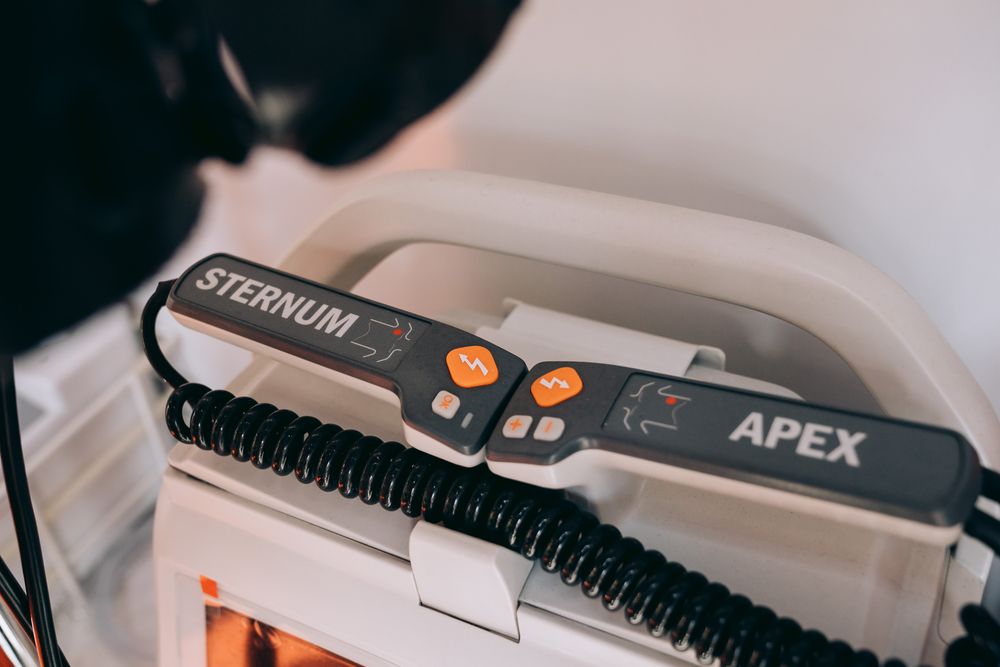
Modern defibrillators are designed for untrained bystanders and give clear spoken instructions. Once one arrives:
- Turn it on and follow the voice prompts.
- Attach the pads to the casualty's bare chest exactly as shown on the diagrams.
- Stand clear while the device analyses the heart rhythm — do not touch the person.
- Deliver a shock if instructed, making sure no one is in contact with the casualty, then resume CPR immediately.
An AED will never deliver a shock unless it detects a rhythm that needs one, so you cannot harm someone by attaching it correctly.
First Aid training from €35
Self-paced, HSA-aligned, certificate the same day — €35 per person.
Building a workplace ready to respond
Knowing the theory is one thing; doing it under pressure is another. That is why hands-on practice on a recognised course is so valuable. Employers can go further by knowing where the nearest AED is, keeping it maintained with charged batteries and in-date pads, and making sure enough staff are trained across all shifts.
The chain of survival
Survival from cardiac arrest depends on a series of linked actions often called the chain of survival: early recognition and calling for help, early CPR, early defibrillation, and prompt advanced care from paramedics. Each link strengthens the next, and a weak link anywhere reduces the chance of a good outcome. Workplaces play a vital part in the first three links, which all happen before professional help arrives.
This is why having several trained staff, a well-maintained AED and a clear plan for who does what matters so much. The faster your team moves through those early links, the better the odds for a colleague, customer or visitor who collapses on your premises.
To understand how this fits your wider obligations, read our guides to first aid at work in Ireland and how many first aiders your workplace needs. The more people who can act, the better the odds for anyone who collapses at work.